
Designing an AI-powered contract management &
e-signature platform
Product Designer | Product Owner
SaaS B2B Legal-tech
Increase adoption / engagement / conversion premium
What is HEU Legal?
A platform that combines document management, advanced editing, and AI in a single collaborative environment.
HEU is a B2B SaaS Legal-tech platform that allows companies to:
• Create contracts using AI
• Manage document repositories
• Review contracts with AI-assisted collaboration
• Manage company roles and workspaces
• Download signed documents with a complete audit trail
As a Product Designer, I worked across the entire document lifecycle:
from generation to signing, up to post-signature management and API integration.


THE PROBLEM
B2B companies manage contracts:
without standardization,
without clear approval flows,
with poor access control,
with poor integration between generation, review, and signing
THE SOLUTION
The goal was to build a platform that:
centralized document management,
automated creation using AI,
guaranteed legal compliance,
supported complex business structures

THE PRODUCT
The platform is divided into 4 macro-systems
Dashboard — Document Management
The dashboard is not just a repository, but a decision-making system that reduces the time it takes to find and manage a contract, improving the team's operational efficiency.
I structured the dashboard around three pillars:
STATUS CLARITY - each contract shows its status, review, approval, or signature.
INSTANT ACTIONABILITY - key actions (edit, AI review, sharing) are accessible without entering the document.
SCALABLE ORGANIZATION - filters, advanced search, categorization by workspace and tags.


Editor — Contracts & Generative AI
A space designed to seamlessly write, generate, and edit contracts.
The editor reduces contract creation time and lowers the barrier for inexperienced users, while maintaining structural and professional control.
CONTEXTUAL AI INTEGRATION - AI is integrated into the writing flow and can be activated inline and maintaining cognitive continuity.
CONTROL AND TRANSPARENCY - all generated content is editable, trackable, and never automatically applied without user confirmation.
MODULAR STRUCTURE - the contract is built with reusable sections and clauses, making it easy to edit, version, and scale the system.
AI Contract Reviewer
It's a tool designed to assist users during the most delicate phase: the review, identifying risks, inconsistencies, and critical points.
The tool increases audit security and reduces potentially critical errors, improving the overall quality of contracts.
It doesn't just suggest changes, but:
- Analyzes critical clauses
- Highlights potential risks
- Reports inconsistencies or ambiguities
- Proposes improvement options


Roles & Workspace
The introduction of clear permission management has reduced operational ambiguity, increased perceived security, and made the product suitable for more complex teams and organizations.
From a simple contracting tool to a structured collaboration platform.
WORKSPACE AS AN ORGANIZATIONAL UNIT - Each Workspace represents an independent environment such as a company, a team or a project area.
HIERARCHICAL SYSTEM OF ROLES - Each role is accompanied by consistent restrictions in the interface, avoiding discrepancies between what the user sees and what they can do.
CLARITY AND FEEDBACK ON PERMISSIONS - This approach increased transparency and trust, two key elements in a legal document context.

Strategic Analysis & Foundations
Systemic understanding of the product through structured analysis, flow mapping, and market research.
Mapping the entire ecosystem: user interactions, touchpoints, backend systems, and AI.
Objective: Highlight dependencies and critical points.
Service Blueprint
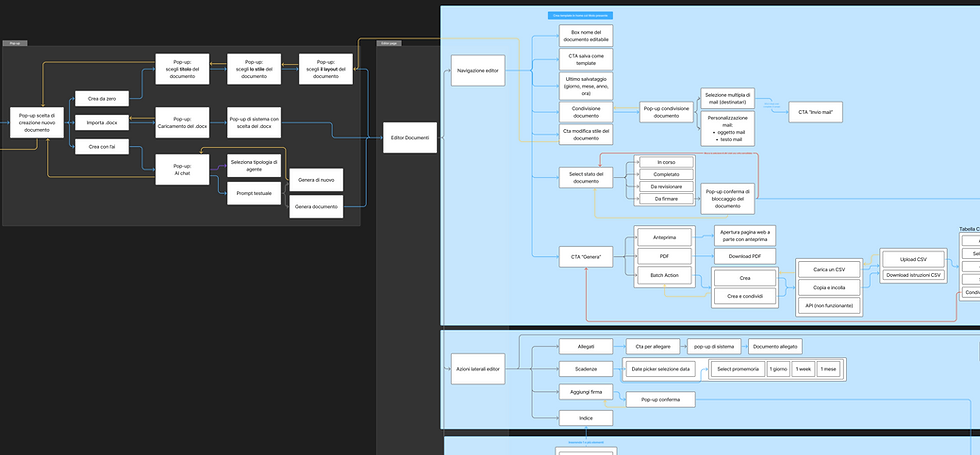
I mapped out key flows to simplify interaction architecture, reduce friction, and integrate AI consistently into the operational workflow.

User Flow & Flowcharts
I used iterative wireframes to validate structure and hierarchy before the final UI, optimizing key actions and content distribution.

Wireframes architecture
Design System — Scalability
I have structured a modular system based on reusable components and shared patterns structured with atomic design.

KPIs & OKRs — MEASURABLE IMPACT
My work in Numbers
+80%
Average ticket value
+64%
Average number of users per customer
+28%
New feature adoption rate
-41%
Churn rate (decreased a lot)
